



 !
!
Here’s the short answer don’t. At least not fully. Persian rugs are hand-knotted, dye-sensitive, and woven from natural fibers like wool or silk that react very badly to the wrong cleaning method. The safest thing you can do for a Persian rug is handle fresh spills yourself using the right technique, then leave the deep cleaning to a professional who knows what they’re doing.
That said if you have a spill happening right now or want to do basic maintenance at home without causing damage, I’ll walk you through exactly what’s safe and what will permanently ruin your rug.
At Green Choice Commercial Carpet Cleaning NYC, we clean Persian rugs regularly across Manhattan, Brooklyn, Queens, and beyond. We’ve also seen what happens when people try to “save money” by cleaning a $2,000–$10,000 rug themselves with the wrong method. It’s not pretty. So read this carefully before you touch that rug.
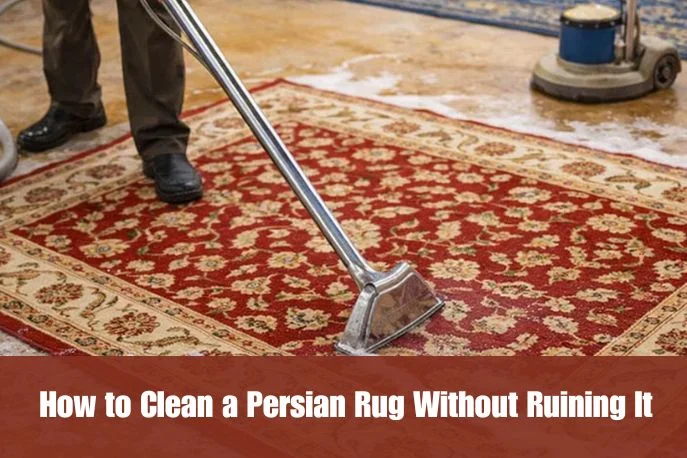
Why Persian Rugs Are So Different From Regular Carpet
Most people treat their Persian rug the same way they’d treat wall-to-wall carpet. That’s mistake number one. Here’s why they’re completely different:
Hand-knotted construction Persian rugs are made by hand, knot by knot. The pile fibers are individually tied around the warp threads. Aggressive scrubbing, stiff brushes, or machine washing physically breaks those knots and loosens the pile. Once the pile starts shedding unevenly, the rug is structurally compromised.
Natural dyes that bleed Traditional Persian rugs use vegetable-based and natural dyes. These dyes are beautiful and they run. Hot water, alkaline cleaners, and excessive moisture cause colors to migrate from one section of the rug into another. A red border bleeding into a cream field is not reversible.
Natural fiber pile wool or silk Wool is pH-sensitive. Alkaline products (most commercial cleaners, dish soap, baking soda) swell the wool fiber, cause shrinkage, and permanently alter the texture. Silk is even more fragile it water-spots easily, weakens when wet, and can be destroyed by any acid or alkaline solution.
Foundation fibers that shrink The warp and weft (the structural grid of the rug) are often cotton or wool. When these get saturated and dry unevenly, the rug warps, buckles, and ripples and no amount of professional cleaning fixes uneven shrinkage.
What You Can Safely Do at Home
Regular Maintenance (Safe to Do Yourself)
Vacuuming — but the right way:
| Do This | Don’t Do This |
|---|---|
| Vacuum the pile surface gently on low suction | Use a beater-bar attachment it breaks pile knots |
| Vacuum in the direction of the pile | Vacuum against the pile it stresses fibers |
| Vacuum the back occasionally to remove loose grit | Use a rotating brush head on silk rugs |
| Use a handheld or suction-only attachment for fringe | Run over the fringe with a standard vacuum head |
Vacuuming frequency: once a week for rugs in high-traffic areas, every two weeks for decorative rugs.
Rotating the rug every 6 months This distributes foot traffic and sun exposure evenly, preventing one section from fading or wearing faster than the rest.
Shaking out small rugs Take smaller Persian rugs outside and shake them gently. This dislodges loose soil from the pile without the mechanical stress of vacuuming.
Handling a Fresh Spill on a Persian Rug
This is where most people cause irreversible damage by reacting too fast with the wrong tools. Here’s the exact sequence:
Step 1 — Blot immediately with a dry white cloth Press straight down and lift straight up. Never rub or wipe sideways. Work from the outer edge of the spill inward to prevent spreading. Use a white cloth only colored cloths can transfer dye onto a wet rug.
Step 2 — Remove solid material first If the spill has solid content (food, mud, pet waste) use a spoon or dull knife to lift it off the surface before blotting. Pressing a cloth onto solid material just pushes it deeper into the pile.
Step 3 — Apply cold water sparingly Dampen don’t soak a clean white cloth with cold water and blot the affected area. Cold water only. Warm or hot water accelerates dye bleeding and sets protein stains permanently.
Step 4 — Blot dry thoroughly After treating, press dry cloths firmly onto the area and weight them down for 10–15 minutes to draw moisture upward. Then allow the rug to air dry completely in a well-ventilated area. Never fold or roll a damp Persian rug.
Step 5 — Call us Even if the spill looks handled, there’s a good chance residue has penetrated to the foundation fibers. Professional cleaning after a spill ensures nothing is left behind to cause odor, mold, or permanent discoloration.
Stain-Specific Guide for Persian Rugs
| Stain Type | Safe DIY Response | What NOT to Use |
|---|---|---|
| Red wine | Blot immediately, cold water, blot dry | Club soda (carbonation can spread dye) |
| Coffee or tea | Cold water blot, work from edges in | Hot water, dish soap |
| Pet urine | Cold water blot + enzyme cleaner (diluted) | Baking soda (alkaline damages wool) |
| Blood | Cold water only, blot firmly | Any warm water, hydrogen peroxide on colored areas |
| Mud | Let dry completely, gently brush off crust, vacuum | Wet scrubbing wet mud drives it deeper |
| Grease or oil | Blot dry first, then lightly apply cornstarch, vacuum after 15 min | Dish soap, any degreaser chemical |
| Ink | Blot only, do NOT try to treat call professionals immediately | Rubbing alcohol bleaches natural dyes |
Cleaning Methods That Will Ruin a Persian Rug
Let me be direct about this because we’ve seen every one of these mistakes:
Steam cleaning / hot water extraction at home — The machines available for rent or purchase by consumers do not have the temperature control or suction power to properly clean and extract a Persian rug. The result is over-wetting, uneven drying, color bleed, and fiber shrinkage. Professional hot water extraction with rug-specific settings and controlled drying is completely different.
Washing machine — This is the fastest way to destroy a Persian rug. The mechanical agitation breaks knots, the heat causes severe shrinkage, and the spin cycle permanently distorts the shape of the rug. We have seen beautiful antique rugs turned into unusable mats this way.
Dish soap or laundry detergent — Both are alkaline. Wool fibers swell and felt under alkaline conditions. The rug will emerge stiff, matted, and with altered pile texture that cannot be reversed.
Leaving it outside in direct sunlight to dry — Prolonged UV exposure bleaches natural dyes unevenly. The wet fibers are also at their weakest when damp UV damage during drying accelerates fiber breakdown.
Stiff brush scrubbing — Breaks pile knots, raises fibers incorrectly, and causes pilling and fuzzing that permanently changes the rug’s appearance.
How Often Should a Persian Rug Be Professionally Cleaned?
| Rug Location & Use | Recommended Professional Cleaning |
|---|---|
| Decorative (low foot traffic) | Every 2–3 years |
| Living room (moderate traffic) | Every 12–18 months |
| Entryway or hallway (high traffic) | Every 6–12 months |
| Home with pets or children | Every 6–12 months |
| After any significant spill | Immediately |
| Antique or very valuable rug | Every 2–3 years with specialist |
What Professional Persian Rug Cleaning Actually Involves
When we clean a Persian rug at Green Choice, it’s not the same process as cleaning wall-to-wall carpet. Here’s what proper professional rug cleaning looks like:
1. Inspection and testing — We test dye stability before applying any solution. Different sections of the same rug can have different dye bleeding tendencies. We identify this before we start, not after.
2. Dry soil removal — Before any water touches the rug, we remove loose dry soil through gentle beating and vacuuming. Applying water to a soil-loaded rug turns dry dirt into mud that penetrates deeper.
3. pH-balanced, wool-safe cleaning solution — We use solutions specifically formulated for natural fiber rugs — neutral pH, no bleaching agents, no alkaline surfactants.
4. Gentle hand washing or controlled extraction — Depending on the rug’s condition and fiber type, we either hand wash with soft brushes working in the direction of the pile, or use controlled low-pressure extraction.
5. Controlled drying — This is critical. The rug is dried flat in a controlled environment with consistent airflow. Uneven drying causes warping and buckling. We don’t rush this process.
6. Pile grooming and final inspection — After drying, the pile is groomed in the direction of the weave and the rug is inspected under light to ensure evenness, color integrity, and cleanliness.
Our Persian Rug and Specialty Carpet Services
We handle specialty rug and carpet cleaning across all of NYC:
Rug & Carpet Cleaning Services:
- Luxury Carpet Cleaning NYC
- Hotel Carpet Cleaning NYC
- Spa Carpet Cleaning NYC
- Country Club Carpet Cleaning NYC
- Real Estate Carpet Cleaning NYC
- Commercial Upholstery Cleaning NYC
We serve all of NYC and surrounding areas:
The Bottom Line
For fresh spills on a Persian rug blot immediately with a white cloth, use cold water sparingly, work from the edges in, and dry thoroughly. That’s your safe zone for home care.
For everything else deep cleaning, set stains, odor removal, pet accidents, or annual maintenance call a professional who specializes in natural fiber rugs. A Persian rug is not a commodity item. It’s an investment, often a family heirloom, and it deserves to be treated as one.
The cost of professional cleaning is a fraction of what it costs to replace or restore a rug that was damaged by the wrong cleaning method at home.
Green Choice Commercial Carpet Cleaning NYC 📍 365 W 50th St, New York, NY 10019 📞 +1 (646) 558-2017
Have a Persian or specialty rug that needs professional attention? Call us we’ll give you a straight answer on what it needs and what it’ll cost before we touch it.
